

New Jersey Gov. Phil Murphy visits Hoboken High School and discusses his proposal for allowing 16- and 17-year-olds to vote in local school board elections.
Prepared by: The New Jersey Center for Civic Education, Rutgers University, Piscataway, NJ
Grade level: Grades 6-8
New Jersey Social Studies Student Learning Standards:
- 6.3.8.CivicsPI.1: Evaluate, take, and defend a position on why government is necessary, and the purposes government should serve.
- 6.3.8.CivicsPD.2: Propose and defend a position regarding a public policy issue at the appropriate local, state, or national level.
Objectives: Students will be able to:
- Gather information in ways that build community partnerships and empower citizenship.
- Identify the purposes and responsibilities of federal, state and local governments.
- Identify the purpose and responsibilities of the agencies and offices within the branches of government for each level.
- Collaborate to develop and prioritize public policy solutions.
- Present and defend public policy solutions for identified public problems.
Gather Information
As students begin considering solutions to public policy problems, they will need to research and gather information. Students should, of course, access relevant online digital resources. However, it is very important to encourage your students to reach out to people and institutions in their community, such as:
- Public policy makers and interest groups
- Community organizations and libraries
- Elected official and administrative agencies
- Scholars, lawyers, and judges
- Local, community, print and broadcast media.
Have your students write letters and emails, make phone calls, interview experts, and extend invitations for speakers to come to class. In this way, students will not only learn about their communities but build community partnerships and experience citizenship empowerment as well.
Identify and Develop Potential Policy Solutions
To identify and develop potential policy solutions, guide students in through the following questions, background and activities.
Is the solution feasible? “Feasible” means capable of being done or carried out with a high degree of success. This is a very practical consideration. You don’t want your students frustrated by a topic that is too narrow to address? Similarly, you don’t want your students to take on an issue that is so broad that the solutions are endless or beyond their ability to address. For example, while addressing global warming is an admirable goal, resolution is a very broad, international concern. Addressing one piece, like reducing carbon usage in their school and/or community, would might be feasible for middle school students..
What are the causes and effects of the problem? When considering any solution, it is important to consider the causes, or source, of the problem. By understanding the source, you decrease the likelihood of wasting valuable resources and increase the chances of finding a permanent solution. In short, knowing why something is broken makes it easier to fix. It is also important to consider the effects, or impact, of the problem. By considering the impact, you can focus your solution on the most serious elements of the problem and avoid creating unwanted side-effects.
Which Level Government Has Responsibility for the Solution? By definition, a public policy problem will involve the government in the solution. However, students will need to consider what level of government has the authority, or is best suited, to address the issue. The United States’ system of federalism includes many layers of government, from the national government all the way to your local school administration and school board.
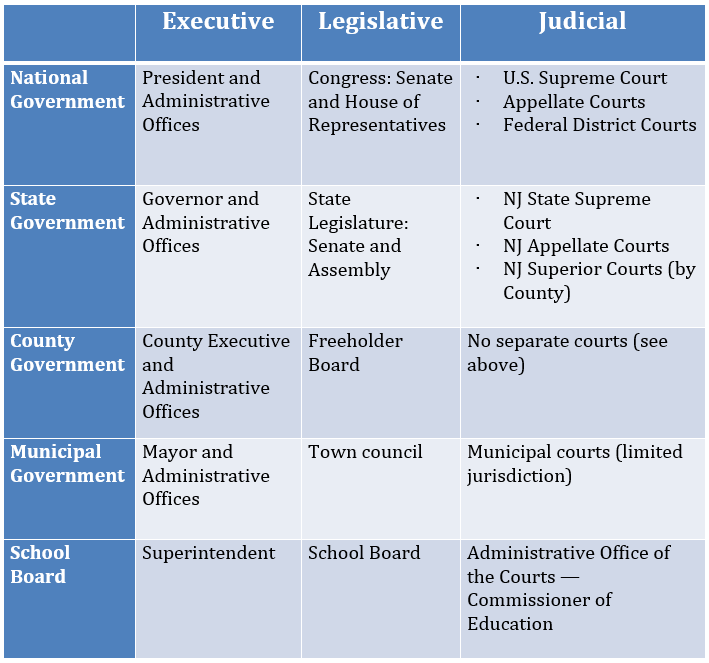
Activity 1: You can use this opportunity for a concrete lesson in federalism. Have students view What Is Federalism? | Things Explained. Then distribute and review Handout1 - Federalism and Separation of Power. Finish by discussing what level of government is best suited to address the problem and create a policy solutions.
Identify Which Branch and Agency of Government Has Responsibility? In addition to the many layers of federalism, the powers or government is separated into three branches: a legislative branch which makes laws, an executive branch which executes and enforces the law, and a judicial branch which interprets the law. The branches do not operate in isolation, however. Their powers are overlapping in ways that each branch can check and balance the other branches’ power. For more information, see
Foundations of the Constitution - Teaching Federalism, Separation of Powers, and Checks and Balances
Explain that the separation of powers and system of checks and balances are also present in state and local governments. For state government, share Your Government | NJ.gov with your students. Instruct students to scroll down and click on “State Government Resources.” For the executive branch, they can click on the Governor’s Office” and “Department Agencies”; for the Legislative Branch they can click on “Find Your Legislator”; and for the Judicial Branch they can click on “Administrative Office of the Court.” For local government, have students go to County and Municipal Web Sites | NJ.gov. Then click on the first letter of their county or municipality. When they click on that county or municipality, it will take them to the website that will provide detailed information on the branches in their local government.
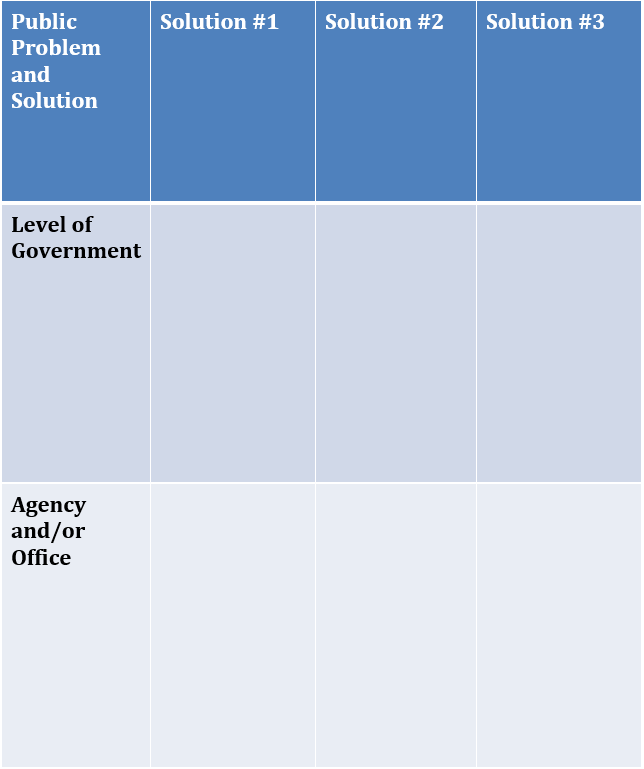
Activity 2: Divide students in small groups of 3-5 students. Have students in each group discuss and brainstorm 2 to 3 potential solutions to the chosen public policy problem. Then distribute Handout 2 - Level of Government and Agency. Instruct each group to list their potential solution along the top row of the chart. Then, considering what they have learned about federalism, separation of powers and checks and balances, decide which level of government has responsibility to address the public policy problem. If they identify local government as the appropriate level, they should identify the county, municipality, and/or school district. Finally, have students identify on the bottom row the most appropriate agency or office to address the public policy problem. For state and local governments, they should use the above links. For national government, they may use A-Z index of U.S. government departments and agencies | USAGov
Activity 3: Distribute one copy of Handout #3 - Examining Alternative Policies for each solution the group has identified. Then have students complete the six steps identified. Inform each group that each analysis will be used to summarize and advocate for their policy solution.
Selecting the Best Solution
Activity 4: After completing Activity 3, each group should discuss and reach consensus on which of the policies is the best solution. To assist that discussion, have students consider the following questions for each policy solution:
- Does the policy solution have a legitimate purpose?
- Is it fair?
- Is it clear?
- Is it flexible?
- Can the policy solution be enforced?
- Is it consistent with constitutionally guaranteed individual rights?
- Which alternative policy solution would best solve the problem?
- Does it address the most important underlying cause of the problem?
- Does it alleviate some of the effects of the problem?
After reaching consensus, each should select 1-2 spokespersons to share out and advocate the group’s chosen policy solution. Once every group has presented, provide time for open class discussion & debate. Upon completion, engage in an informal survey of the class to determine if consensus can be reached on the best policy solution. If no consensus can be reached, move students to a more formalized vote. Inform students that they can only vote for one solution and should vote on the merit of the proposals. (Closed paper ballots can be most effective.)
Extension: You may wish to explore Project Citizen with your students. Project Citizen is a project based civic education program for students grades 3-12. Entire classes of students work cooperatively in small groups to effect change in their community. Students develop a digital portfolio that documents their research about a public policy problem and proposes solutions and an action plan for implementation. The student portfolio can be shared with others at your school, policymakers in your community, or at a New Jersey State Showcase at Rutgers University in June. (For examples of student portfolios, see Project Citizen Portfolios)
Project Citizen emphasizes responsible participation in local and state government and develops a sense of civic empowerment. For more on the curriculum see Project Citizen. For more on the New Jersey State showcase watch New Jersey Project Citizen Showcase 2025. Finally, if you are interested in attending a free, full-day Project Citizen workshop, visit https://civiced.rutgers.edu/professional-development/upcoming-workshops.
Handout 1-
Federalism and Separation of Powers
Handout 2 - Level of Government and Agency
Handout 3 - Examining Alternative Policies
Solution #_ - ___________________
Identify your potential solution for dealing with the problem you have chosen. Your solution may include an existing policy, or one being proposed by individuals or groups in the community. Or your solution may be your own original idea for policies to address the problem.
For your solution, complete the following steps:
- State the suggested policy.
- Identify the individual or group that is proposing the policy (this could be your own class or group).
- Identify the advantages of this proposed policy.
- Identify the disadvantages of this proposed policy.
- Identify other individuals or groups in the community who are likely to support this policy.
- Identify other individuals or groups in the community who are likely to oppose this policy.
Use the bottom of this page to write your answers for each policy you identify. Use additional pages if necessary.