
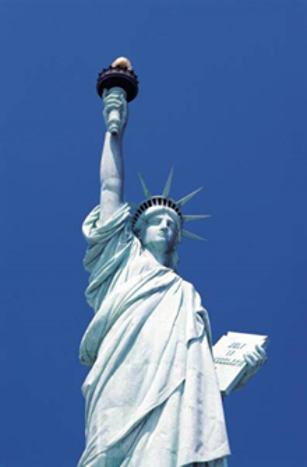
Statue of Liberty-on-Liberty Island in New York Harbor
Prepared by: The New Jersey Center for Civic Education, Rutgers University, Piscataway, NJ
Grade Level: 6-8
Objectives: Students will be able to:
- Explain the different meanings of “liberty”.
- Analyze the relationship between natural rights, liberty, and democracy.
- Identify the definition of “liberty” most important for understanding American government.
- Describe how the idea of liberty is sometimes misunderstood or misused.
- Explain what the idea of liberty means for citizens.
- Evaluate the concept of “ordered liberty” and explain why it was important to the Founders.
- Identify situations where freedom to act should be limited.
New Jersey Student Learning Standards for Social Studies (2020):
6.3.8.CivicsPI.1: Evaluate, take, and defend a position on why government is necessary, and the purposes government should serve.
6.3.8.CivicsPI.2: Evaluate the extent to which different forms of government reflect the history and values of various societies (e.g., monarchy, democracy, republic, dictatorship).
6.3.8.CivicsDP.2: Make a claim based on evidence to determine the extent and the limitations of First Amendment rights (e.g., U.S. Supreme Court decisions).
6.3.8.CivicsDP.3: Use historical case studies and current events to explain why due process is essential for the protection of individual rights and maintenance of limited government.
6.3.8.CivicsPR.3: Take a position on an issue in which fundamental ideals and principles are in conflict (e.g., liberty, equality).
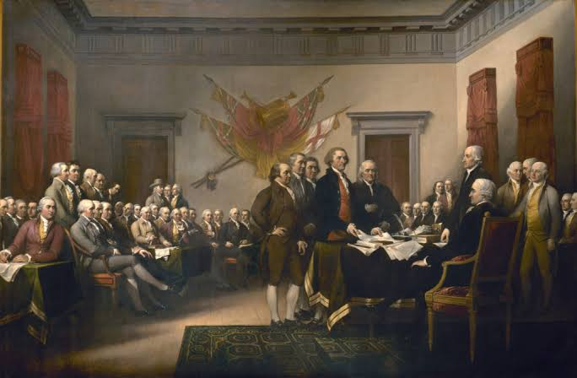
The signing of the Declaration of Independence, “The Founding Moment,” by John Trumbell
Background: What is “liberty”?
Adopted by the Continental Congress on July 4, 1776, the Declaration of Independence announced that the 13 American colonies were free and independent states, no longer under British rule. The Declaration’s most famous passage states that all men are created equal and are endowed by their Creator with certain unalienable rights, among them Life, Liberty, and the pursuit of Happiness. It asserts that:
- Governments are created to secure these rights.
- Governments derive their just powers from the consent of the governed.
- When a government becomes destructive of these ends, the people have the right to alter or abolish it and establish a new one.
In short, the Declaration grounds political legitimacy in the protection of natural rights—especially liberty—and affirms the people’s ultimate authority to defend those rights.
The Declaration of Independence, Rights and Liberty - Center for Civic Education
The Preamble to the United States Constitution includes “to secure the Blessings of liberty” as one of the purposes for forming the government of the United States. The idea of liberty is at the very core of American democracy.
Introductory Activity: Ask students: What is “liberty”? Listen to suggestions, write them on the board, and discuss.
Why It Matters: Liberty or freedom (the words often are used interchangeably) are important foundational concepts in the study of American government. Natural rights are the freedoms people are born with; liberty is the ability to exercise those freedoms. Discussions about how to best protect liberty and ensure that every citizen enjoys its benefits are an important part of democracy and have been a part of American politics since the Founding. In order to have these important discussions, there must be a general agreement about what the words mean so that everyone is talking about the same thing.
Philosophers have argued about “liberty” or “freedom” for centuries and there are over 200 known definitions of the words. It is easy to see how this could cause a lot of confusion. People and governments have used, misused, and redefined the words to suit their purposes. Some definitions of liberty are as simple as being able to do what you want. Some link freedom to being a better kind of person by holding a particular value that their society considers important. Some governments have argued that a person is only free when they hold certain values and therefore by forcing citizens to think and behave in a certain way the government is not oppressing them, but making them more “free” (yes, that is confusing!). These governments are usually some form of dictatorship, and that is why it is important that the United States chose a different definition of freedom. It matters that American citizens appreciate the necessity of understanding how the words “freedom” or “liberty” are used in our democracy.
For most Americans, freedom is the absence of limits or restrictions on a person’s activities. It is about determining the appropriate amount of space to allow an individual to make her or his own decisions and choices about how to live their life. The fewer limitations a person has, the more space they have to act, the greater their freedom. Freedom is limited when the actions of other people restrict what a person can do, especially if a government unfairly places limits on a person. This is the most important definition for understanding American government.
Ordered liberty, as understood by the American Founders, means genuine individual freedom exercised within a framework of law, moral order, civic virtue, and constitutional limits—not unbounded license to do whatever one wants.
The Founders consistently distinguished liberty from license. Liberty is the rightful exercise of natural rights (life, liberty, property, pursuit of happiness) under just laws that protect everyone’s equal rights. License is unrestrained will that harms others, undermines social order, or destroys the conditions that make freedom possible. Without order, liberty collapses into chaos or the rule of the strongest; without liberty, order becomes tyranny. The “pursuit of happiness” was not just doing whatever feels good. It meant the opportunity to live a good life—flourishing through virtue, industry, family, and community—within a free society. Unordered passion or pure self-interest was seen as incompatible with lasting republican government. As Benjamin Franklin observed: “only a virtuous people are capable of freedom.”
Critical Thinking Exercise: Life, Liberty and the Pursuit of Happiness
In the Declaration of Independence, Jefferson ordered the rights as “life, liberty, and the pursuit of happiness”. Explain the reasoning behind this sequence. Why must “life” come before “liberty,” and “liberty” before the “pursuit of happiness”?
Freedom Only as Space to Act: The definition we are focusing on describes freedom as simply the amount of space an individual has to act without restraints from other people. It is nothing more than that. There is no attempt by the government to tell people what to think or to force them to hold certain values. A person could choose to waste their life rather than strive to achieve some higher ideal. Perhaps they want to spend their time playing video games. That is not the government’s concern, so long as what the person chooses to do does not interfere with the right of others to pursue their liberty and happiness. This raises an important question:
Is Freedom Unlimited?
The fewer restraints on a person, and the more space they have to act, the greater amount of liberty or freedom they can enjoy. At first, that seems simple, but some people misunderstand this idea. Freedom or liberty does not mean that everyone can just do whatever they want, whenever they want. That is the simplified misunderstanding. Think back to the earlier study of the idea of the social contract. In the ideal state of nature, everyone had absolute freedom, but they couldn’t enjoy it because of the conflicts that would arise between people.
One thinker, Sir Isaiah Berlin, wrote:
“Men [all humans] are largely interdependent, and no man’s activity is so completely private as never to obstruct the lives of others in any way.”
Critical Thinking Exercise: What does this mean for the amount of freedom that an individual can actually enjoy?
People interact with each other on a daily basis. Sometimes we have different goals and interests. We may compete for scarce resources. All of this makes conflict inevitable. As you recall, social contract theory said that one of the reasons people make governments is to help resolve these conflicts. This is the idea of government as a sort of referee.
We also enter into society and a social contract with a government to be more efficiently free. Imagine you lived completely independently of others and there was no government or any other institutions. You would have to be your own police force, fire department, farmer, butcher, grocer, doctor, etc. You would be too busy to actually enjoy your absolute freedom. We cooperate with others so that we can better (more efficiently) enjoy the freedom that we do have, but this means that we also have certain obligations to our fellow citizens.
So where are the limits on our freedom? A famous phrase attributed to several thinkers is “My freedom to extend my arms ends where your nose begins.” A free society should seek to maximize the amount of freedom of its citizens, but there are necessary limits. To repeat an idea from above, citizens are free to act so long as their actions do not interfere with the equal right of others to also enjoy their freedom.
This is why we have laws limiting certain activities. You cannot drive 100 miles per hour through a school zone because those it would injure could not then enjoy their freedom. You cannot engage in behavior that would make others sick, preventing them from being free to pursue their vision of happiness. We sometimes put limits on powerful individuals or corporations so that they do not abuse their wealth and power in a way that robs other citizens of their liberty. Discussions about what limits should be placed on the behavior of individuals and groups to ensure freedom are among the most important discussions citizens of a democracy can have. These limits may shift and change depending on the situation. In times of war, emergency, or pandemic, a society may decide to temporarily limit certain behaviors more than they would in better, more peaceful times. Enjoying freedom usually requires placing some restrictions on absolute unlimited freedom. However, in a free society, there must always be a core amount of liberty, a clearly defined space in which the individual is free to act, that no person and no government can ever trespass or violate.
What are “the Blessings of Liberty”?
Americans, and many people around the world, value the idea of liberty as providing the best opportunity for people to pursue their idea of happiness and enjoy a productive life. The Founders saw this as a great “blessing”, something very beneficial for the American people.
Class Discussion - What were the “Blessings” that the Founders hoped would come with liberty?
The “Blessings of Liberty” included the hope that individuals would pursue their vision of happiness to the best of their abilities (individual choice) and, as a result, would enhance the economic and political development and prosperity of the nation. They hoped that liberty would provide the necessary space and opportunity for people to be inventive and creative, and to freely share ideas for the benefit of all. But, this was not a guarantee.
Group Activity – Students should work in groups to discuss and answer the following questions. The final step requires each group to create a real-life scenario that demonstrates how the blessings of liberty empower people to pursue happiness.
1. What are the first words you think of when you hear the word "happiness"?
2. How do you think happiness is defined by most people?
3. How has happiness been defined in popular culture?
4. What does it mean to pursue something?
5. Does pursuing something require a certain mindset?
6. What are some things you would like to pursue?
7. Is pursuing something the same as chasing something?
8. Is there a different mindset when someone is chasing something? Explain.
9. Why are so many young people unhappy today?
10. Why do some believe that virtue and liberty are in conflict?
11. What is the result of such a belief?
12. Students are to write a scenario that demonstrates how a person “performs” or “practices” the pursuit of happiness in any life situation.
“To Secure the Blessings of Liberty”
The Founders used words carefully. It is useful to consider why they chose the words they used in the Preamble of the Constitution. They knew that liberty was not something that people could always enjoy without any effort. It was something that needed to be protected and secured from the threats that could deprive a society of its liberty.
If the United States was to remain a free democracy, it had to be made secure from both the foreign and domestic threats it would always face. The foreign threats are easy to understand. There are always non-democratic nations whose interests will conflict with the United States. That is why the Founders provided for the “common defense” and granted the government the necessary powers to create military forces.
The Founders were more concerned about the domestic threats to liberty. They knew that if the United States was ever to cease to be a republic, the threat would more likely come from its own citizens than a foreign power. That is why they designed the system of checks and balances and other mechanisms to limit government power. It is why the Bill of Rights was added to the Constitution to put specific protections of liberty in writing in the “supreme law of the land”. It is why Benjamin Franklin, when asked what kind of government the Constitutional Convention had created, reportedly responded “A republic, if you can keep it.”
The Founders focused on liberty—freedom from governmental restraints—by writing limits on what government could do into the Bill of Rights. For example, the First Amendment limits the government from interfering with individual freedom of religion, speech, press, assembly and petition.
Checking for understanding: What other sections of the Constitution protect individual liberty by limiting what the government can do?
Responses should include:
- Art. I, Sec. 9 denies Congress certain powers, including the suspension of writ of habeas corpus (requiring a person under arrest to be brought before a judge or into court and to secure the person's release unless lawful grounds are shown for their detention), bills of attainder (legislative bills that imposes punishment without a trial), and ex post facto laws (laws that retroactively changes the legal consequences of actions)
- Arts. I-III Separates powers into three branches, each with limited authority
- Second Amendment functions as a constitutional barrier that prevents government from disarming the people, thereby protecting both personal self-defense and a broader structural safeguard for a free political order
- Fourth Amendment prohibits the government from invading an individual’s privacy
- Fifth Amendment prohibits the government from depriving an individual of life, liberty or property without due process
- Eighth Amendment prohibits excessive bail or fines or cruel and unusual punishment.
The Founders knew that the greatest responsibility for maintaining our democracy rested with the citizens themselves. Yet, they also recognized that people could be selfish, power hungry, or willing to trespass on the rights and freedoms of others. One of the misunderstandings of freedom or liberty is that it means people are free to always act selfishly, and that this ultimately leads to good consequences. The founders took a more nuanced approach. They recognized that people are selfish and tried to channel this into a productive competition among competing interests (see Madison, Federalist 10). But they also expected that citizens of a democracy must practice a certain amount of civic virtue and expected that the American people would always be able to do this. They knew that if selfishness prevailed and civic virtue failed, we would not remain a republic.
Enjoying liberty, or the ability to act with limited restrictions on our behavior, means that we also must govern ourselves in a way that respects the equal rights of others to enjoy their freedom and pursue their happiness. This means that citizens must also be willing to act for the Common Good. The common good is an important concept, without which enjoying liberty is impossible. Any conception of the common good must respect and secure the core of liberty every citizen is guaranteed, but the two concepts are inseparable. A free democracy cannot have one without the other. (see lesson about the Common Good)
Extension Activity: The Statue of Liberty
Background:
"The Statue of Liberty Enlightening the World," which sits in New York Harbor, was a gift of friendship from the people of France to the United States. It was designed by Frederic Bartholdi with engineering help from Gustave Eiffel (who built the Eiffel Tower in Paris) on the internal structure. The Statue of Liberty was erected atop a pedestal built by the United States on Bedloe’s Island (renamed “Liberty Island”) in Upper New York Bay and dedicated by Governor Grover Cleveland on October 28, 1886.
The statue of “Lady Liberty” is named after the Roman goddess, Liberty or “Libertas”. It is 305 feet tall and weighs 225 tons. It was shipped in pieces on boats across the Atlantic Ocean. The structure is an iron frame with a copper shield outside. Originally “cooper” colored, copper turns to a green patina when it oxidizes in the weather. Lady Liberty holds a tablet with the date of the Declaration of Independence, July 4, 1776, as well as a torch, lighting the way to freedom.
From 1886 until 1901 the statue with its torch was used as a lighthouse. In 1924, Lady Liberty was designated as a National Monument. The Statue of Liberty has been recognized as a universal symbol of freedom. Over the years, it has welcomed millions of immigrants and refugees escaping wars, persecution and/or poverty to the United States.
Class Discussion: Share Handout One: The New Colossus by Emma Lazarus with students. Have students discuss the message that they think the Statue of Liberty is trying to convey: How does the Statue of Liberty frame our understanding of liberty? How does the poem by Emma Lazarus change or extend the original purpose of the Statue of Liberty?
HANDOUT ONE: The New Colossus
BY EMMA LAZARUS
Not like the brazen giant of Greek fame,
With conquering limbs astride from land to land;
Here at our sea-washed, sunset gates shall stand
A mighty woman with a torch, whose flame
Is the imprisoned lightning, and her name
Mother of Exiles. From her beacon-hand
Glows world-wide welcome; her mild eyes command
The air-bridged harbor that twin cities frame.
“Keep, ancient lands, your storied pomp!” cries she
With silent lips. “Give me your tired, your poor,
Your huddled masses yearning to breathe free,
The wretched refuse of your teeming shore.
Send these, the homeless, tempest-tost to me,
I lift my lamp beside the golden door!”